

September 6, 2026
You passed the PMP exam. You saw the preliminary result and celebrated. Then days later an email arrived that your score has been canceled....

You studied for months, and you took the test. You felt good walking out. Then the letter arrives. Your score is canceled. The reason? Answer similarity analysis. You didn’t copy anyone or look at another paper.
But the ACT’s algorithms decided your answer pattern matched someone else’s closely enough to destroy everything you worked for.
This is not a rare mistake; it happens every single test date.
And the worst part is that most of you never see it coming because you don’t know the system exists.
This guide explains exactly how does ACT detect cheating. We will explain how their statistical cheating detection works, what triggers a flag, and how to make sure you never become its next victim.
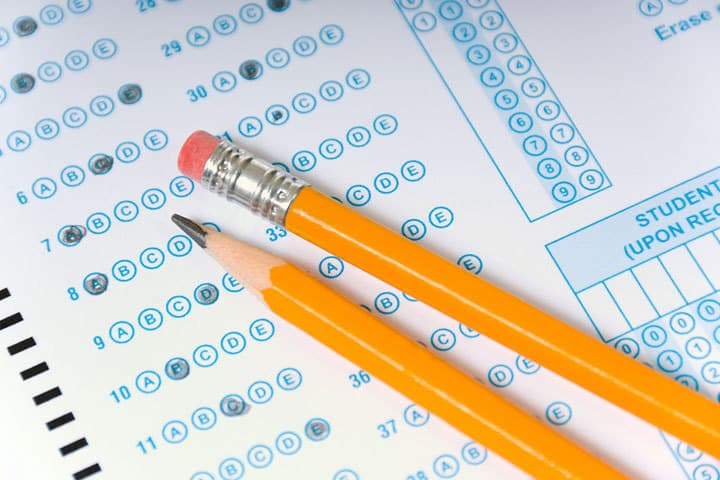
The ACT has a test security division that uses statistical modeling to hunt for cheaters. Their primary tool compares your answer sheet to every other student who took the same test form in the same room. The model looks for patterns that are statistically unlikely to occur by chance. It does not look for proof; it looks for probability.
Every question has a correct answer and four wrong ones. When two students answer independently, some of their answers will match by chance. The model calculates how many matches are expected between two random students. If your answer sheet matches another student’s far beyond that expected baseline, the system flags both of you.
The model pays special attention to wrong answers. Getting the same correct answer is common because there is only one right choice. But matching the same wrong answer on a hard question is much more suspicious.
Why did both of you pick B when the correct answer was D? That specific error pattern is what the ACT’s statisticians look for. They call it “implausible agreement.” If your wrong answers align too closely with someone else’s wrong answers, the system decides the odds of that happening naturally are too low.
The ACT never releases the exact thresholds that trigger a flag. That would tell cheaters how to beat the system. But based on our research, industry documents, and public statements, we know several factors play into it.
The statistical method used is called a collusion index. It’s similar to what the SAT and other testing companies use. The index produces a number that represents how unlikely your answer agreement is. If that number crosses a certain threshold, the score gets held.
Answer similarity is the primary trigger, but it’s not the only one. The ACT also monitors score changes from one test to the next. If you took the ACT as a sophomore and scored a 21, then jumped to a 32 as a senior, the system takes notice.
A score jump alone won’t cancel your score. Students improve dramatically all the time. They study, they take prep courses, they get tutors. The ACT knows this. But a big jump combined with other factors makes the flag much more likely.
Both tests use answer similarity analysis. But the ACT is more aggressive in some ways.
The SAT’s model, run by the College Board, also flags unusual answer patterns. But the SAT has more test forms in circulation and often uses different versions in the same room. That makes direct answer comparison harder. The ACT’s room-level analysis is tighter because the test forms are more consistent across a testing center.
The ACT also relies more heavily on proctor reports. Test center proctors are trained to watch for wandering eyes, phones, and passing notes. A proctor report combined with a statistical flag is often enough to cancel a score.
Yes. This is the most unfair part of the entire system and how ACT detects cheating. A perfect score can trigger a review even if there is no evidence of collusion.
If you get every question right, the model can’t find an answer similarity match because there’s no wrong answer pattern to compare. But a perfect score is so rare that it automatically gets flagged for human review.
The reviewer looks at your previous scores, your proctor report, and your answer timing. If everything looks clean, the score stands. But if there’s any irregularity, a proctor noted you were looking around, you finished unusually fast, or you took the test at a center with a history of cheating, your perfect score could be held.
This is why some top students have their ACT scores canceled for no reason other than being exceptional. The system is designed to assume you’re guilty until proven innocent.
If you’re reading this because you’re about to take the ACT and you’re worried about scoring high enough, you have two choices. You can study, hope the algorithm doesn’t falsely flag you, and deal with the stress of an uncertain outcome. Or you can remove the algorithm from the equation entirely.
Our service takes the ACT for you. You sit in front of the webcam, complete the check-in, and act like a normal test-taker. Our expert controls your keyboard and mouse from our end, answering every question with precision. The score comes back clean. There is no answer similarity to flag because there is no second person in the room and no suspicious pattern to detect.
We guarantee a score above 30. If your score falls below 30, you get a full refund. That’s the confidence that comes from having taken this exact exam for hundreds of students without a single cancellation.
The process of how ACT detects cheating and its statistical analysis is a weapon aimed at every test-taker. Don’t stand in its line of fire. Let us handle the exam while you focus on the college applications that matter.
You passed the PMP exam. You saw the preliminary result and celebrated. Then days later an email arrived that your score has been canceled....

Pearson VUE OnVUE has fully upgraded its AI proctoring and biometric identification technology. PMP candidates are now walking into a surveillance net far more...

To avoid a PMI-RMP exam revoked notice, you need to understand exactly what triggers a misconduct investigation. This will ensure you never end up...

[…] The ACT does not need a proctor report. It does not need to catch you in the act. It just needs your answer sheet to match another student’s wrong answers too closely, and your score is held. […]
[…] The problem with every one of these methods is execution. They work in theory. Some work in practice. But they all depend on you doing something unusual while a proctor watches, AI tracks your face, and the screen recording captures every move. One mistake and you are flagged. […]