NR667 CEA Final Diagnostic Exam FNP October 2026 Verified Questions
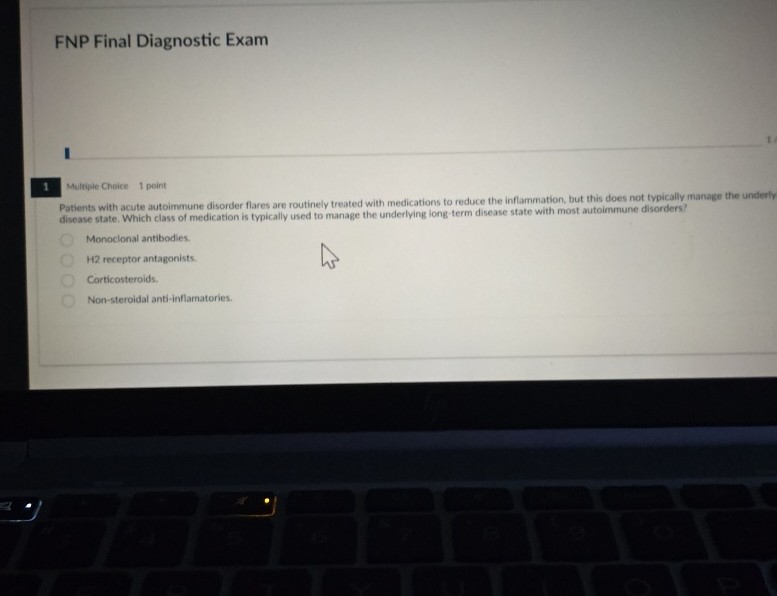
Question 1: Patients with acute autoimmune disorder flares are routinely treated with medications to reduce the inflammation, but this does not typically manage the underlying disease state. Which class of medication is typically used to manage the underlying long-term disease state with most autoimmune disorders?
• Monoclonal antibodies.
• H2 receptor antagonists.
• Corticosteroids.
• Non-steroidal anti-inflammatories.
Correct Answer: Monoclonal antibodies.
Question 2: The patient who inappropriately exhibits fear of abandonment, intense interpersonal relationships, affective instability, and recurrent self-harm describes which of
the following diagnoses:
• Bipolar disorder.
• Borderline personality disorder.
• Reactive attachment disorder.
• Seasonal affective disorder.
Correct Answer: Borderline personality disorder.
Question 3: Which class of medications is indicated as first line management of both post-traumatic stress disorder (PTSD) and major depressive disorder?
• Selective serotonin reuptake inhibitors.
• Mood stabilizers.
• Non-selective dopamine reuptake inhibitors.
• Monoamine oxidase inhibitors.
Correct Answer: Selective serotonin reuptake inhibitors.
Question 4: Your patient Helen presents with difficulty understanding words, but speaks words in response effectively and follows written commands but not verbal commands.
This most likely suggestive of a stroke in which of the following areas?
• Wernicke’s area
• Post-central sulcus
• Occiputal area
• Brocas area
Correct Answer: Wernicke’s area
Question 5: Your 41 year old female patient recently underwent two separate cath lab procedures, first for diagnostic angiography and subsequently for percutaneous coronary
intervention. She presents to you for a routine post-hospital discharge visit. When evaluating their labwork, you notice a platelet count of 60,000 on today's visit. It was
140,000 12 days ago prior to the diagnostic angiogram. Which of the following diagnoses
needs to be ruled out for this patient?
• Heparin Induced Thrombocytopenia (HIT)
• Thrombotic Thrombocytopenic Purpura (TTP)
• Reactive thrombocytosis
• Idiopathic Thrombocytopenic Purpura (ITP)
Correct Answer: Heparin Induced Thrombocytopenia (HIT)
Question 6: Kevin, a 19 year old male, presents to your clinic with a racing feeling in his chest. An EKG is performed, and you have diagnosed him with supraventricular tachycardia
(SVT) at a rate of 220 and call for emergency medical services (EMS). Which of the following is a likely extrinsic cause of his rhythm?
• Drinking caffeinated energy drinks
• Supplementing with vitamin D 5000 IU daily
• Supplementing with vitamin C 5000 IU daily
• Congenital presence of a bypass track in the heart
Correct Answer: Drinking caffeinated energy drinks
Question 7: The most commonly described non-life threatening adverse effect of HmgCo-A
reductase inhibitor therapy is which of the following?
• Rhabdomyolysis.
• Airway swelling.
• Tachycardia.
• Myalgia.
Correct Answer: Myalgia.
Question 8: Rosie, a 19 year old college student presents to the student health services for
evaluation of abdominal pain. She has a history of Crohn’s disease with partial small bowel
resection which has been managed well on natalizumab (Tysabri), a monoclonal antibody.
Her abdomen is distended, tender, and she describes frequent bloody stools. Based on her current presentation, what medication decisions are most appropriate at this time?
• Stop natalizumab (Tysabri) as it is not safe during flares
• No change is needed, continue on current dosing of natalizumab (Tysabri)
• Add adalimumab (Humira) to her natalizumab (Tysabri)
• Initiate prednisone (Deltasone) and maintain dosing of natalizumab (Tysabri)
Correct Answer: Stop natalizumab (Tysabri) as it is not safe during flares
Question 9: While assessing the 15 year old patient for a new onset cough, the nurse
practitioner may inspect, auscultate, palpate, and/or percuss. How does performing percussion of the thorax assist the provider during the physical examination?
• To assess for any pain or discomfort prior to palpitation of the chest wall.
• To assess for deep-seated lesion and tumors.
• To assist with the confirmation of cardiac origin of angina.
• To identify if underlying tissue are air-filled, fluid-filled or consolidated.
Correct Answer: To identify if underlying tissue are air-filled, fluid-filled or
consolidated.
Question 10: Melody is complaining of lip smacking and odd facial movements she cannot control for the last two days after starting on medication for management of her
schizophrenia. Which of the following is most likely to cause this?
• Olanzapine (Zyprexa)
• Isocarboxazid (Marplan)
• Perphenazine (Etocort)
• Amitriptyline (Elavil)
Correct Answer: Perphenazine (Etocort)